Integrated Word Study in Action
Planning a literacy lesson shouldn’t feel like flat-pack furniture without the instructions.
A reliable, repeatable framework for bringing phonology, morphology, vocabulary, syntax and orthography together, so you can plan and teach integrated word study without piecing it together from scratch every week.
You’re teaching decoding well, but there’s a nagging feeling you should be doing more for vocabulary.
So you add it in.
Then morphology needs a place. Syntax matters too. And you want students to carry what they’re learning into reading and writing, not just get another isolated activity.
Before long, one literacy session has become a phonics drill, a morphology activity, a vocabulary list, a decodable text and a writing task sitting beside each other.
All good pieces.
Not quite one lesson.
You want students to be curious about words. Spotting patterns. Bringing you something they noticed in a book and asking why it works that way.

Instead, the session moves from slide to worksheet to the next scheduled activity, and you can feel them switching off.
Death by PowerPoint has entered the room.
And while the students experience five separate activities in a row, you’re the one spending Sunday night trying to make them connect before Monday morning.
Pulling the morphology activity from one resource. The vocabulary from another. Finding a text that is at least vaguely related. Working out what comes first, what belongs together and whether you’ve somehow left out something important.
You have all the pieces.
You shouldn’t have to work out how to assemble the whole lesson every week.
"I've taught all the pieces before, but never connected them like this. It's been a revelation."
-Justine, Speech Language Pathologist.
At some point, the learning has to become a lesson.
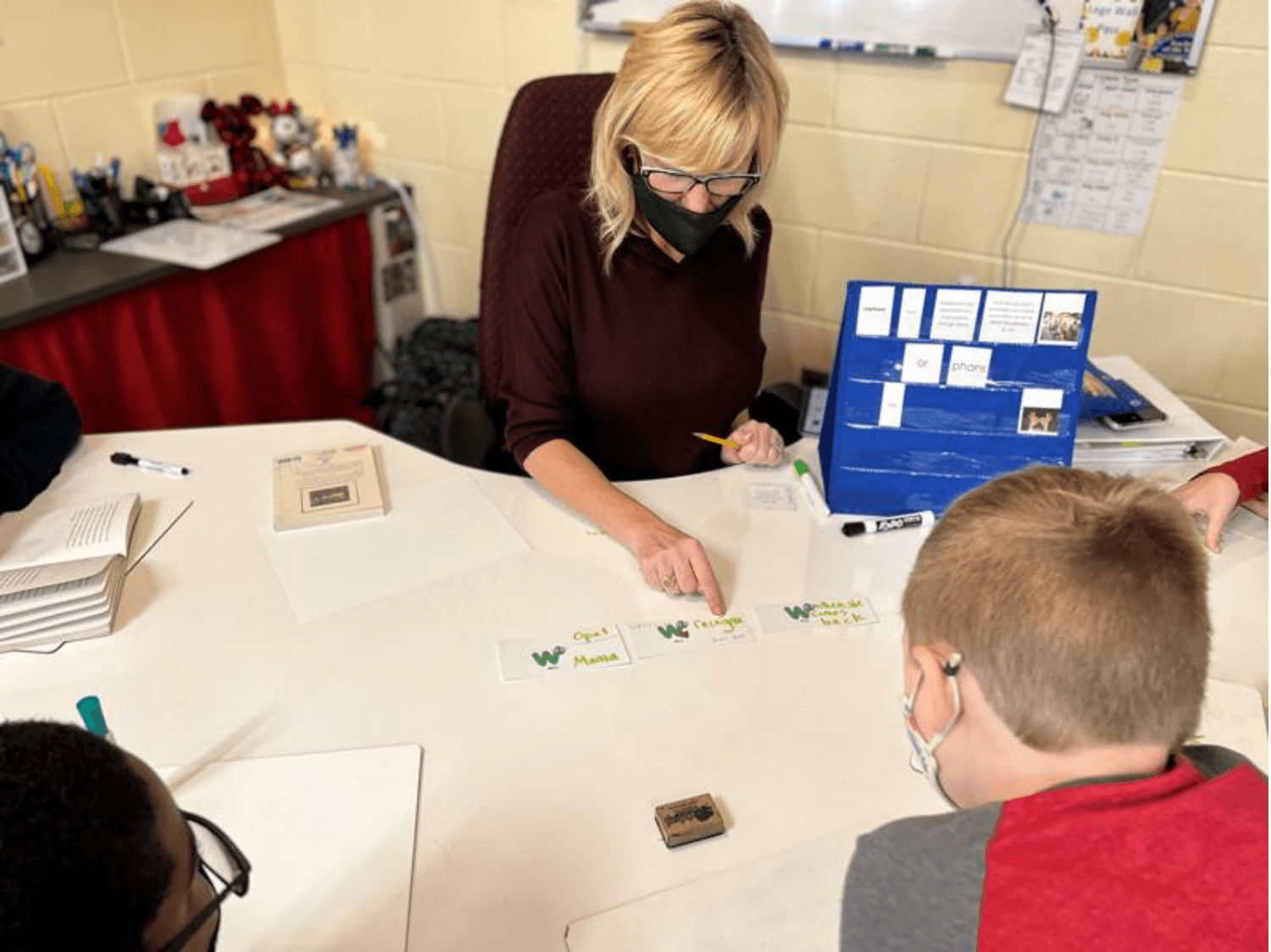
It makes sense to keep reaching for more knowledge.
There’s a lot to understand about phonology, orthography, morphology, vocabulary, syntax and meaning. So it’s easy to think that the next course, book or training will be the thing that finally makes it all feel clear.
But the difficulty usually isn’t knowing that each part matters.
It’s knowing how to bring them together in one lesson.
How to connect this week’s decoding focus to morphology. How to choose vocabulary that belongs with the text. How to build towards writing, rather than adding another activity at the end and hoping the learning transfers.
When a student spells a word phonetically but not accurately, and you’re deciding how to address this in the next lesson.
When a student understands the meaning but can’t use the word in writing, and you can see the learning hasn’t transferred yet.
When several parts of the language system are involved and you’re not sure which one the lesson should centre on.
That’s where more information can start to pile up instead of helping.
Because literacy is often taught to educators in separate pieces, while the work of putting those pieces together is left to you.
But language doesn’t work in separate pieces.
And neither should the lesson.
Integrated Word Study in Action
Knowing the research is not the same as knowing what to do next.
Integrated Word Study gives you a clear way to turn phonology, morphology, vocabulary, syntax and orthography into one connected literacy lesson.
Instead of planning each part separately, you learn how to choose what belongs, connect it to the lesson focus and sequence it so the learning builds.
You’re not adding another activity because it feels like you should.
You know why it’s there.
You know what it connects to.
And you know what can wait for another lesson.
That’s what makes the planning more manageable and the teaching more coherent.

One lesson. One clear thread.
Every part working together.
Learn how one, connected lesson is built.
Then use the framework to build your own.

Four fully modelled lessons across a structured literacy progression
Work through four complete literacy lessons across Level 1, Level 3, Level 4 and Level 6.
Each lesson shows how phonology, morphology, orthography, vocabulary and syntax can be brought together around one clear focus.
You’ll see what belongs in the lesson.
What can be left out.
Why one component comes before another.
And how each part builds towards the next.

A repeatable framework for planning your own sessions
The same planning framework sits underneath every lesson, whether you’re teaching a whole class, a small group or one student.
It gives you a clear way to decide:
What the lesson is building towards.
Which literacy components support that focus.
How they should connect.
And what can wait for another session.
So you’re not starting from an empty page or trying to fit every domain into every lesson.
You have a structure you can use with your own students, texts, resources and scope and sequence.

Session notes for every lesson
See the full lesson sequence laid out clearly, including the focus, the components included and how the lesson moves from one part to the next.
Use the notes as a practical reference when planning your own sessions.

The full sequencing framework
Keep the framework beside you while you plan, so you can see the structure at a glance and work through each decision without holding the whole lesson in your head.

Photos of real student workbooks
See how Integrated Word Study looks on the page, how the components connect in students’ work and how the lesson carries through into practice.
Join Integrated Word Study in Action
Integrated Word Study in Action:
$197 USD
Inside, you’ll get:
Four fully modelled lessons across Level 1, Level 3, Level 4 and Level 6
The Integrated Word Study planning framework
Session notes for every lesson
The full sequencing framework
Photos of real student workbooks
Have a question before you enrol?
Send me a message here
You can teach systematically without teaching from a script.

Whether you’re teaching a whole class, running a small intervention group or working one-to-one, the students in front of you won’t look exactly like the students in someone else’s lesson plan.
You may have a scope and sequence your school expects you to follow. You may teach six-year-olds, sixteen-year-olds or both. The lesson focus, the words and the level of complexity will change.
Integrated Word Study in Action doesn’t ask you to throw any of that out or squeeze your students into another rigid program.
It gives you a framework for looking at what you’re already teaching and deciding what belongs, what connects and what can wait.
So you can keep the structure.
And keep using your professional judgement.
Built from Two Decades’ Worth of Experience in the Classroom

Hi, I’m Sarah Mitchell. I’ve spent almost two decades teaching struggling literacy learners, planning lessons across the different domains of literacy, and figuring out what actually shifts learning outcomes when other approaches have failed.
I graduated with a Bachelor of Primary Education and haves since gone on to complete a Master of Education, Special Education in the Advanced Research Pathway. On top of that, I also hold OCR Level 7 Graduate Diploma in Teaching and Assessing Learners with SpLD, a qualification that permits making a formal diagnosis of dyslexia, dysgraphia and dyscalculia, and spent seven years as a specialist teacher and Literacy Coordinator at Fairley House School in London, one of the world’s leading specialist schools for students with dyslexia.
But here’s what the qualifications won’t tell you: this framework didn’t come from study. It came from the moments when the lesson plan I’d pieced together from various resources no longer helped. From observing what moved the needle for student outcomes, then reverse engineering how to build that into my lessons.
I built this framework and program because I couldn’t find anything that went deep enough. A resource that didn’t just show you what to teach, but how to plan across all the domains in a coherent, well-sequenced and engaging way.
This is what Integrated Word Study in Action is: two decades of classroom experience distilled into a framework you can use to plan and sequence any literacy session.
This is the moment that makes all the work worth it.
When a student who has always found spelling difficult starts to realise that words aren’t random.
When something from the lesson appears later in their reading or writing.
When they bring you a word they’ve noticed somewhere else because they’re beginning to see how language works.
That’s why you do it.
Because beneath all the planning, the training and the pressure to get it right, you want to know your teaching helped.
That you made something clearer. Made learning feel a little more possible. Helped one child read.
Frequently Asked Questions
You may recognise some of the concepts, but this is not designed to give you another overview of structured literacy.
Integrated Word Study in Action is about what happens after the knowledge, when you are trying to sequence phonology, morphology, vocabulary, syntax, and orthography into one lesson that actually holds together.
You’ll see how the lesson is built: what goes first, what connects to what, and why. what goes first, what connects to what, and why. If you already have strong literacy knowledge, this may be the piece that helps you organise it into a lesson that flows.
Not if you are ready to see how the pieces fit together in practice.
You do not need to know everything before you begin. The course is designed to make the sequencing explicit, so you can see how phonology, orthography, morphology, syntax and meaning connect inside a single lesson.
If you’re still building your knowledge, this gives you a framework to organise what you’re learning instead of trying to piece it together alone.
No. Integrated Word Study in Action is for student-facing literacy educators.
That includes classroom teachers, intervention teachers, specialist literacy teachers, tutors and speech-language pathologists. The setting may change, but the work is the same.
No. You don’t need to abandon the scope and sequence you already use.
The framework helps you sequence what you’re already teaching so the different components support each other. You can bring integrated word study into your existing sequence, not replace it.
You don’t need to work through hours of content before this becomes useful.
The modelled lessons are designed to help you see the sequencing clearly so you can take the framework into your next lesson. You can work through a modelled lesson, understand how it’s structured and start applying the framework straight away.
The four modelled lessons span Level 1, Level 3, Level 4 and Level 6, and would suit anyone teaching primary students, middle school students, or older struggling students. The four lessons give you a grounding in moving from foundational literacy skills all the way to advanced morphology and etymology.
The exact content may shift depending on the students in front of you, but the sequencing framework applies across year levels and ability groups.
Yes! This approach helps target the needs of students with decoding difficulties, language difficulties, and English language learners. The framework helps you to seamlessly integrate all parts of literacy, meaning all learners are targeted so that you can say goodbye to photocopying 5 sets of worksheets before every lesson.
This approach is suitable for older students who may be struggling in particular. Explanations and Word Work is age respectful and engaging.
Yes. You do not need a diagnosis to notice that a student is struggling with reading, spelling, writing or understanding how words work.
Integrated Word Study in Action is built around sequencing, so the different parts of your literacy session connect and build towards the same learning focus, whether a student has a diagnosis or not.
No. Everything you need to participate in Integrated Word Study in Action is included in the course.
The Teaching Structured Literacy Series can be useful companion resources if you want the broader sequence and supporting materials, but they are not required before you begin.
© 2026 Sarah Mitchell, Integrated Word Study. All rights reserved.